
The Rise of Edge Computing: What It Means for Enterprises in 2025
The Rise of Edge Computing: What It Means for Enterprises in 2025By Gauri Kulkarni | July 30, 2025 | Technology Trends & Innovation
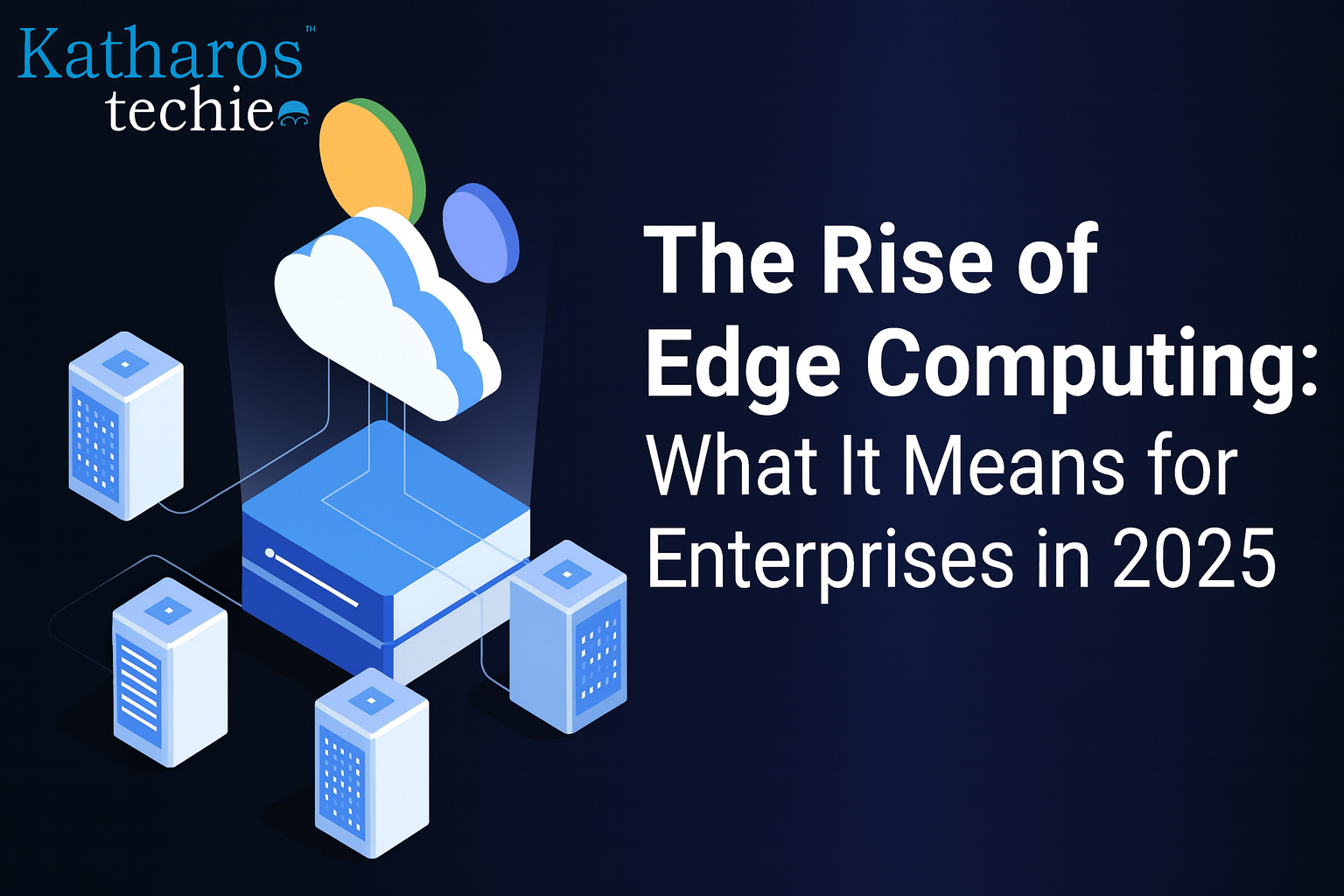
Edge computing is rapidly becoming a core part of enterprise technology strategy in 2025. For more than a decade, cloud computing has been the foundation of digital transformation. Centralized servers, scalable storage, cost-efficient infrastructure, and global accessibility made the cloud indispensable. But as businesses adopt real-time systems, automation, IoT workloads, and AI-driven operations, the limitations of a cloud-only model have become clear. Edge computing fills this gap by processing data closer to where it is generated rather than sending everything to distant cloud data centers. Let's understand what the rise of edge computing is and what it means for enterprises in 2025.
Why Edge Computing Matters for Modern Enterprises

One of the biggest reasons enterprises are shifting to edge models is the need for instant, real-time decision-making. Industries such as manufacturing, healthcare, logistics, mobility, smart cities, and retail rely on systems that must react within milliseconds. A factory robot adjusting its movement, a medical device monitoring vitals, an automated checkout system detecting purchases, or a delivery tracker updating live location—none of these can afford network delays.
Latency in cloud-only setups slows down operations and reduces accuracy. Edge computing eliminates this challenge by placing computation right where the action happens, enabling immediate responses.
Reducing Latency and Improving Performance
Enterprises increasingly adopt edge solutions because low latency directly impacts operational performance. An edge node deployed on a factory floor or inside a hospital ensures that critical applications don’t have to wait for cloud round trips. This leads to faster automation, improved quality control, safer operations, and enhanced user experiences. For sectors depending on instant data insights, edge performance is not just a benefit; it’s a necessity.
Stronger Security and Regulatory Compliance
Security is another major driver of edge adoption. Many organizations handle sensitive, personal, or regulated data that cannot always be transmitted to the cloud due to privacy laws or business policies. With edge computing:
- Sensitive data can be processed locally
- Only non-critical or aggregated data is sent to the cloud
- Exposure to external threats is reduced
- Enterprises maintain better control over compliance
This balance between edge for immediate, local processing and cloud for long-term storage, analytics, and governance is quickly becoming the standard across industries.
Cost Optimization Through Local Processing
As IoT devices, smart sensors, high-resolution cameras, and connected systems multiply, the amount of data enterprises generate each day has exploded. Sending all this raw data to the cloud is expensive and inefficient.
Edge systems filter, preprocess, and analyze data locally, sending only the most important information to cloud platforms.
This leads to:
- Lower bandwidth usage
- Reduced cloud storage costs
- More efficient workload distribution
- Significant savings for large-scale deployments
For businesses running thousands of endpoints across multiple locations, edge computing offers a cost-effective and scalable alternative.
Greater Scalability and Resilience
Scalability in modern enterprises isn’t just about adding more cloud instances; it's about managing distributed systems intelligently. With thousands of devices generating data simultaneously, businesses need infrastructure that can operate independently and reliably.
Edge nodes provide:
- Local autonomy even during network downtime
- Higher uptime for mission-critical systems
- Distributed load handling
- Reduced dependence on central servers
This distributed architecture makes enterprises more resilient, especially in environments where connectivity is inconsistent.
AI at the Edge: The Next Frontier of Intelligent Operations
One of the fastest-growing trends in enterprise technology is AI at the edge. Instead of sending data to the cloud for processing, AI models now run directly on devices.
This enables:
- Real-time anomaly detection
- Predictive maintenance
- Personalized user interactions
- Automated decision-making
- Operations in remote or offline environments
Industries like agriculture, mining, oil & gas, energy, and remote logistics benefit immensely because they often operate in locations with limited internet access. Edge-based AI ensures that devices remain intelligent, responsive, and reliable even without stable connectivity.
Edge and Cloud: A Powerful Hybrid Architecture
A common misconception is that edge computing replaces cloud computing. In reality, they complement each other.
- The cloud remains essential for large-scale analytics, AI training, backups, reporting, and centralized management.
- The edge is ideal for time-critical, location-specific, or bandwidth-heavy tasks.
Enterprises are increasingly adopting hybrid edge-cloud architectures, which combine the strengths of both systems to deliver agility, intelligence, and operational efficiency.
5G Is Accelerating Edge Adoption
The rollout of 5G networks is a major catalyst for enterprise edge computing. With higher bandwidth and ultra-low latency, 5G enables devices and edge nodes to communicate faster and more reliably.
Together, 5G and edge computing unlock advanced use cases such as the following:
- AR/VR training and experiences
- Autonomous systems
- Smart factories and warehouses
- Hyper-connected retail environments
- Real-time video analytics
This synergy is a game changer for industries seeking real-time responsiveness and hyper-automation.
Challenges and the Need for the Right Edge Strategy
Despite its benefits, edge computing introduces new complexities. Distributed environments require:
- Stronger security frameworks
- Advanced monitoring tools
- Data governance policies
- Skilled teams to manage infrastructure
- Strategic partnerships with technology providers
Enterprises must choose the right platforms, deployment models, and security measures to fully leverage edge capabilities.
Conclusion: Edge Computing Is Now Essential for Enterprise Growth
In 2025, edge computing is no longer experimental; it is a strategic necessity. Businesses aiming for speed, efficiency, resilience, and innovation are investing heavily in edge technologies. Those that adopt early gain a strong competitive advantage by delivering faster, smarter, more connected digital experiences.
Enterprises that embrace edge-cloud hybrid models will be the ones driving the next wave of digital transformation.
Also read: http://127.0.0.1/techie/the-rise-of-edge-computing-transforming-data-processing/

Related Blogs

Let us digitalize your ideas.
Contact Us