Custom Software Development vs Off-the-Shelf Solutions
Custom Software Development vs Off-the-Shelf SolutionsBy Gauri Kulkarni | August 14, 2025 |
1. Understanding the Two Paths
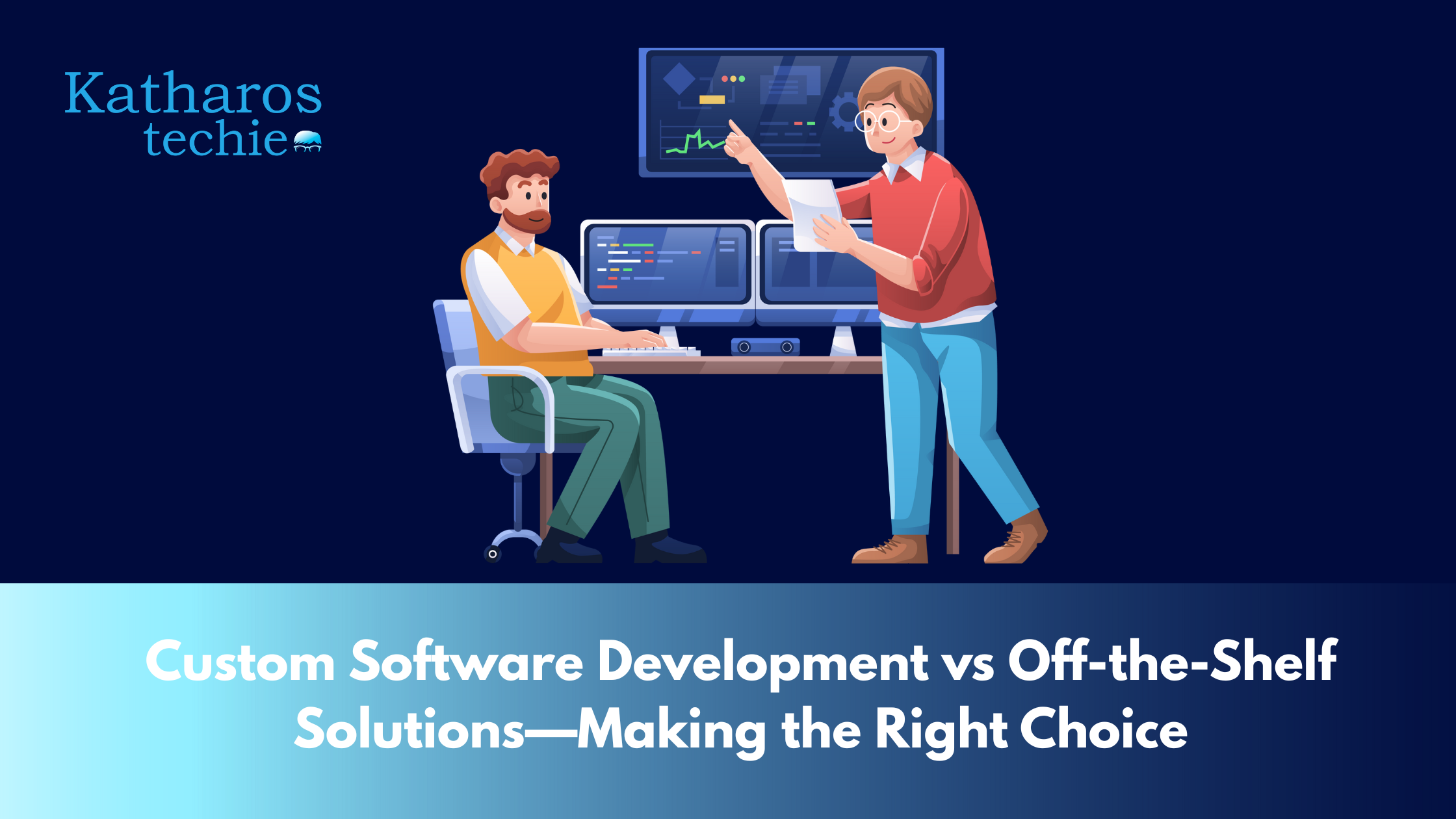
Every modern business relies on software—whether it’s for operations, customer engagement, workflow automation, or scaling into new markets. But one of the most important decisions companies face today begins with a simple yet powerful question: Should we build our own software, or should we buy an existing solution?
This choice affects everything. Your efficiency, cost structure, long-term flexibility, and even competitive advantage. Both options offer strong benefits, but the right path depends heavily on your goals, your timeline, and how unique your business processes are.
1.1 What Is Custom Software?
Custom software is a fully personalized solution built specifically to support your unique business needs. Instead of adjusting your workflow to fit a pre-made tool, the software adjusts to you. This approach offers full control over features, integrations, user experience, scalability, and future enhancements. If your company has specialized processes or wants to deliver a differentiated digital experience, custom development gives you unmatched freedom.
1.2 What Are Off-the-Shelf Solutions?
Off-the-shelf software refers to ready-made tools that you can purchase or subscribe to and start using immediately. They are designed around standard industry practices and built to accommodate the needs of a broad user base. These solutions often come with preset features, templates, workflows, dashboards, and support services, making them convenient and budget-friendly for most organizations—especially those that don’t need heavy customization.
2. Where Custom Software Shines

Custom development becomes especially valuable when your business needs go beyond what generic SaaS platforms offer. If your internal processes are unique, or if you want to innovate and stand out in a competitive market, custom software can unlock possibilities that prepackaged tools simply can’t match.
2.1 Tailored to Your Business
Custom software is designed to match the exact way your organization works. Every button, feature, workflow, and integration is built to support your team’s real-life challenges. There’s no excess clutter, no unnecessary modules, and no limitations imposed by someone else’s logic. This alignment improves accuracy, efficiency, and user satisfaction.
2.2 Scales With Growth
As your business grows, your custom software grows with you. New features can be added without disrupting existing operations. If you enter new markets, expand teams, or integrate advanced technologies like AI or automation, the solution evolves smoothly. This long-term scalability makes custom software a strong investment for businesses with future-focused strategies.
2.3 Stronger Integration Possibilities
Many businesses rely on multiple internal systems, such as ERPs, CRMs, finance software, HR portals, or industry-specific tools. Custom development makes integrations seamless, so all systems communicate without manual effort. Better integration means better data accuracy and smoother workflows across teams.
2.4 Competitive Advantage
One of the biggest benefits of custom software is differentiation. When you build technology that competitors don’t have—and can’t easily copy—you gain a clear competitive edge. Whether it’s a unique customer portal, an internal automation engine, or an industry-specific logic, custom software helps position your brand as innovative and advanced.
3. Where Off-the-Shelf Solutions Make Sense
Ready-made software products are often the fastest way to get teams up and running, especially when your requirements aren’t highly specialized. For many early-stage or budget-conscious businesses, off-the-shelf tools deliver strong value quickly.
3.1 Fast Deployment
Since these platforms are already built, tested, and polished, you can start using them immediately. There’s no development cycle, no design planning, and no long wait time. This makes them ideal for businesses that must act fast—such as startups or companies undergoing urgent digital transformation.
3.2 Lower Initial Cost
Off-the-shelf tools are subscription-based, which keeps upfront costs low. You pay monthly or yearly, depending on your needs. This makes the solution more accessible to smaller teams or businesses that want predictable expenses.
3.3 Industry Best Practices Included
These platforms are usually developed based on common work patterns across thousands of businesses. That means you instantly gain access to workflows, templates, and features that are proven to work. For organizations that don’t have highly unique requirements, this is more than enough.
3.4 Regular Updates and Support
Software vendors take care of everything, from security patches to version updates to technical support. You don’t need an internal development team because maintenance is automatically handled by the provider.
4. Limitations to Consider
Before choosing your path, it’s important to understand the challenges and limitations that come with each option.
4.1 Custom Software Limitations
Custom development requires more time and a higher initial investment. You also need ongoing technical support, and the quality depends on the expertise of your development partner. For businesses with extremely tight timelines or limited budgets, this may not be ideal.
4.2 Off-the-Shelf Limitations
With pre-built tools, you must adjust your workflows to match the software, not the other way around. You may face restrictions on customization, integrations, user limits, or feature expansion. Additionally, you don’t own the technology, so vendor decisions or price changes can directly affect you.
5. Questions to Help You Decide
The smartest way to choose is to evaluate your business priorities, resources, and long-term strategy.
5.1 How Unique Are Your Workflows?
If your processes are highly specific or part of your competitive identity, custom software is usually the better fit.
5.2 What’s Your Time-to-Market Pressure?
If you need a solution running tomorrow, off-the-shelf is the clear winner.
5.3 What’s Your Long-Term Vision?
Software built for immediate convenience may create limitations later. Think about where your business will be 2–5 years from now.
5.4 Do You Need Control Over Data & Security?
Industries with strict data governance, finance, healthcare, legal, and logistics often prefer custom solutions for higher control.
There is no universal answer.
The right choice depends entirely on what your business needs today and what it aims to achieve tomorrow. Companies focused on innovation, scalability, and differentiation often lean toward custom development. Meanwhile, businesses prioritizing speed, affordability, and simplicity usually choose off-the-shelf software.
When you understand your priorities clearly, the decision becomes far easier and far more strategic.
Also read: http://127.0.0.1/techie/custom-software-development/


Related Blogs
Let us digitalize your ideas.
Contact Us